Water Heater Element Tester
Enter the resistance reading from your multimeter (in ohms) to determine if your water heater element is functioning properly.
If your hot water suddenly runs out faster than it used to, or you’re stuck with lukewarm showers in the middle of winter, chances are your water heater element has given out. It’s one of the most common failures in electric water heaters - and it’s usually easy to diagnose without calling a plumber. You don’t need special tools or years of experience. Just a multimeter, a little patience, and a few safety steps.
Understand how your water heater works
Most electric water heaters in homes have two heating elements: one near the top and one near the bottom. The top element heats water first, then switches off when the upper half reaches temperature. Then the bottom element kicks in to finish heating the rest. If one element fails, you’ll still get some hot water - just not enough. That’s why people often think their water heater is "going bad" when it’s really just one element that’s dead.Gas water heaters don’t have elements - they use a burner at the bottom. So if you have a gas unit, this guide doesn’t apply. Focus only if your heater runs on electricity and has a control panel with two thermostats.
Signs your water heater element is bad
Here’s what to look for before you even touch a tool:- You get hot water for a few minutes, then it turns cold - and stays cold for hours.
- Only the top half of your tank is hot. Fill a bucket from the hot tap and feel the temperature difference between the first few liters and the rest.
- The water takes way longer to heat up than it used to - like 2-3 hours for a full tank.
- You hear popping or crackling sounds when the heater turns on - this often means mineral buildup is smothering the element.
- The breaker trips every time you turn on the heater, especially after using hot water.
These aren’t proof alone - but they’re strong clues. The only way to know for sure is to test the element.
Turn off power before you do anything
Safety comes first. Even if the heater is off, the wires inside are still live if the breaker isn’t flipped. Find your home’s electrical panel and turn off the breaker labeled "Water Heater" or "Electric Water Heater." Some homes have two breakers - one for each element. Turn both off. Then, use a non-contact voltage tester on the wires leading to the heater to double-check they’re dead. Don’t skip this step. You’re not just protecting your tools - you’re protecting yourself.Gather what you need
You only need three things:- A multimeter (digital is fine - you can buy one for under $20 at any hardware store)
- A screwdriver (flathead or Phillips, depending on your panel cover)
- Optional: a bucket and towels - water might drip when you remove the element cover
That’s it. No special skills, no expensive gear. If you’ve ever changed a lightbulb, you can do this.

Access the heating elements
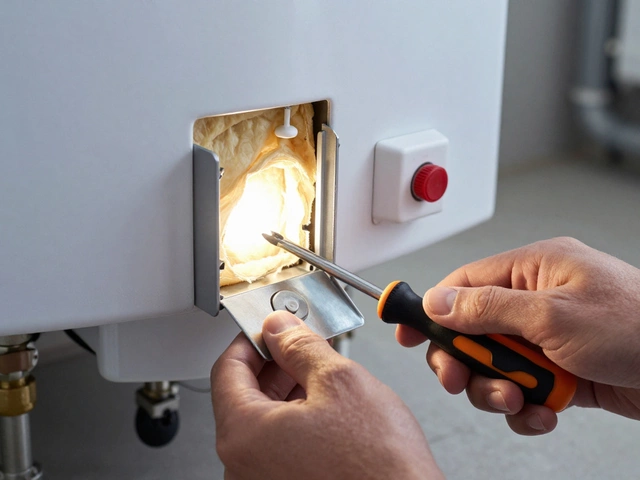
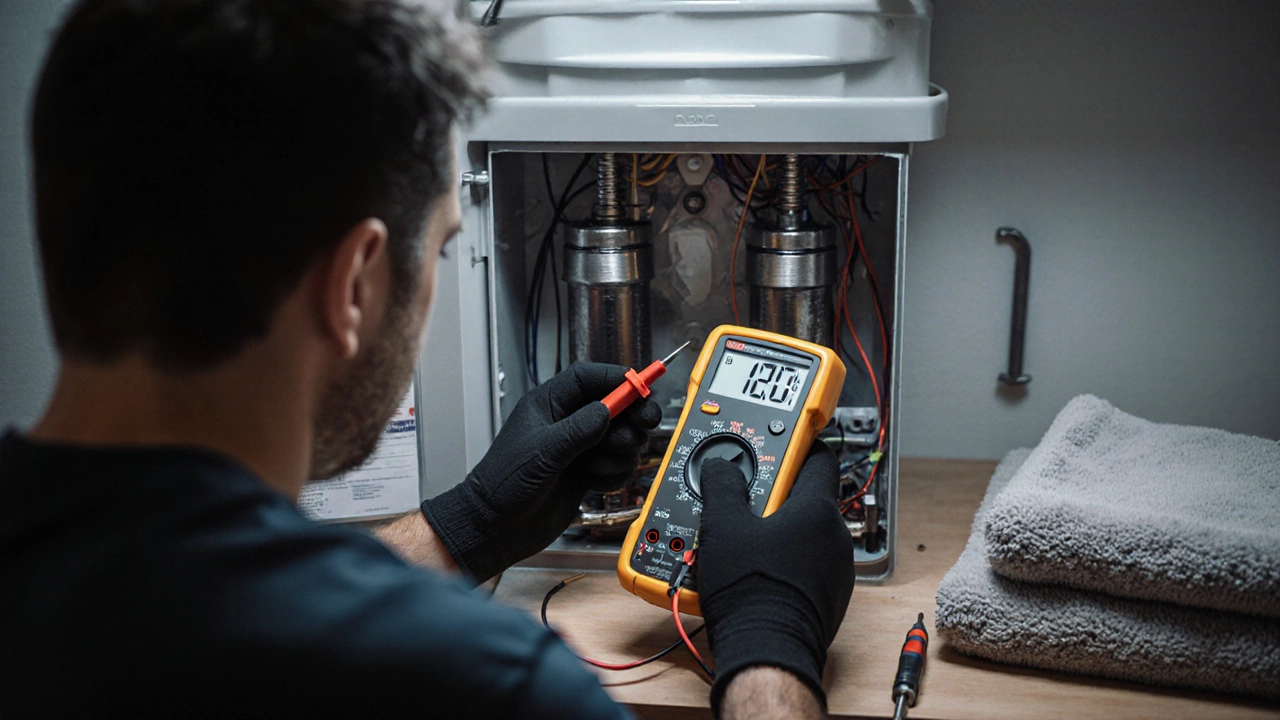
Most electric water heaters have a metal panel on the side, usually near the top and bottom. Remove the screws holding the panel in place. Behind it, you’ll see insulation. Pull back the insulation carefully - it’s not dangerous, but it’s messy. You’ll find two metal cylinders with two wires each. These are your heating elements.Each element has two terminals - metal posts where the wires connect. These are what you’ll test. Take a photo with your phone before disconnecting anything. That way, you remember which wire goes where.
Test the element with a multimeter
Set your multimeter to the resistance setting (ohms, symbol Ω). Turn the dial to 200 Ω or the lowest setting. Touch one probe to each terminal on the element. Don’t touch the metal casing - only the two screw terminals.Here’s what the reading means:
- Between 10 and 16 ohms: The element is good. This is normal for a 4500W or 3500W element.
- 0 ohms (no reading): The element is completely dead. The internal wire is broken.
- Infinite ohms (OL or 1): Same as above - open circuit. Replace it.
- Reading between 20 and 50 ohms: The element is weak or failing. It might still work, but it won’t last.
Now, test for a ground fault. Put one probe on a terminal and the other on the metal casing of the element. If you get any reading - even 1 ohm - the element is shorted to ground. That’s a safety hazard. Replace it immediately.
What if both elements test fine?
If both elements show normal resistance, the problem might be with the thermostats. The top thermostat controls the bottom one. If the top thermostat fails, the bottom element won’t turn on - even if it’s perfectly healthy. A bad thermostat often causes the same symptoms as a bad element: no hot water after the first few minutes.Thermostats can’t be tested with a multimeter alone. You’d need to bypass them temporarily - which isn’t safe for beginners. If your elements are good and you’re still not getting hot water, it’s time to call a licensed electrician. Replacing thermostats requires working with live wires, and the risk of shock is high if you’re not trained.

Replacing a bad element
If you’ve confirmed a bad element, replacement is straightforward - but you’ll need to drain the tank first. Turn off the cold water supply valve at the top of the heater. Open a hot water tap in your house to let air in. Then attach a garden hose to the drain valve at the bottom and run it to a floor drain or outside. Drain until the water level is below the element you’re replacing.Unscrew the old element using a socket wrench. Don’t force it - if it’s stuck, use penetrating oil and wait 10 minutes. Clean the hole with a wire brush. Wrap the threads of the new element with Teflon tape (3-4 wraps). Screw it in tight, but don’t over-torque. Reconnect the wires exactly as they were. Replace the insulation and panel. Refill the tank before turning the power back on. Air trapped in the tank can burn out the new element.
Prevent future failures
Water heater elements don’t fail randomly. They die because of hard water. Minerals like calcium and magnesium build up on the element, making it work harder and overheat. Over time, that burns out the wire.To extend your element’s life:
- Flush your tank every 6-12 months - especially if you have hard water.
- Install a water softener if your water hardness is above 120 mg/L.
- Set your thermostat to 50°C (122°F). Higher temps speed up mineral buildup.
- Replace anode rods every 3-5 years. They sacrifice themselves to protect the tank - and the elements.
These steps won’t stop wear entirely - but they can double or even triple the life of your elements.
When to replace the whole water heater
If your water heater is over 10 years old and you’re replacing elements more than once, it’s probably not worth it. Tank corrosion, rust on the pipes, or leaks around the base mean the tank itself is failing. A new water heater costs $800-$1500 installed, but you’ll save on repairs, energy bills, and the risk of flooding.Modern units are 20-30% more efficient. If your old heater is pulling 12kW to heat water, a new one might use only 9kW. That adds up over time.
Don’t wait for a flood. If your heater is older than 10 years and you’re doing repairs, start shopping for a replacement. Look for models with a 10-year warranty and a glass-lined tank.
Can a water heater element fail without tripping the breaker?
Yes. Most element failures are open circuits - meaning the wire inside breaks, and no current flows. That doesn’t overload the circuit, so the breaker stays on. You just get no heat. Breakers trip only if the element shorts to ground or draws too much current - which happens less often.
Why does my water heater make noise even after replacing the element?
That noise is usually mineral buildup in the tank, not the element. Even after replacing the element, sediment still sits at the bottom. When the new element heats up, bubbles form around the sediment, causing popping or rumbling. Flush the tank thoroughly to fix it. If the noise continues, you may need a professional cleaning or a tank replacement.
How long should a water heater element last?
In soft water, a good element can last 8-12 years. In hard water areas like Adelaide, 4-6 years is more common. Regular maintenance - flushing the tank and checking the anode rod - can push that toward the longer end. If your element dies in under 2 years, check your water quality and thermostat settings.
Is it safe to test a water heater element with the power on?
Never. Testing requires touching exposed metal terminals. Even with the thermostat off, the wiring can still carry live voltage. Always turn off the breaker and verify with a voltage tester before touching anything. A single mistake can be fatal.
Can I use a generic replacement element?
Yes - as long as it matches the voltage, wattage, and size. Most Australian water heaters use 240V, 3500W or 4500W elements. Check the label on the old one. Length matters too - some are short, some are long. If you’re unsure, take the old element to a plumbing supplier and match it exactly. Using the wrong one can cause overheating or poor performance.
Final thoughts
Knowing how to test a water heater element saves you hundreds of dollars in service calls. It’s not rocket science - just a few basic steps. Most people assume their heater is broken beyond repair. But often, it’s just one small part that’s failed. And replacing it? That’s a weekend job you can do yourself.Still, if you’re uncomfortable with electricity, don’t push it. Call a licensed electrician. But if you’re willing to turn off the breaker and use a multimeter, you’ve already done the hardest part: deciding to take control. Now you know how to find the problem - and fix it.