Key Takeaways for Oven Owners
- Most electric oven failures stem from burnt-out heating elements or faulty thermostats.
- Replacing a part is usually 70-80% cheaper than buying a new oven.
- Safety is non-negotiable; always disconnect power before opening the chassis.
- Modern ovens with digital touchscreens are more complex but still repairable via modular board swaps.
The Core Anatomy of Your Oven
To understand if a fix is possible, you have to know what's happening under the hood. An electric oven is a kitchen appliance that uses electrical energy to produce heat through resistive heating elements. It doesn't rely on a flame, which actually makes it safer and often easier to diagnose than a gas counterpart.
At its heart, the oven relies on a Heating Element. This is a metal coil that glows red when electricity passes through it. When this coil cracks or burns out, the oven stops heating. Then there's the Thermostat, which acts as the brain, telling the element when to turn off so your cookies don't turn into charcoal. Finally, you have the Control Board, the computer chip that manages timers, temperature settings, and the display.
Common Culprits: Why Your Oven Stopped Working
Usually, when an oven "breaks," it's not the whole machine failing, but one specific component giving up. If you notice your oven is taking forever to heat up or only heats from the bottom, you're likely looking at a failed bake or broil element. These elements have a limited lifespan; the constant expansion and contraction from heat eventually cause the internal wire to snap.
Another common headache is the temperature calibration. If your oven says it's 200°C but your thermometer says 160°C, the thermostat is likely skewed. In older models, this was a mechanical dial that could be adjusted with a screwdriver. In newer models, the temperature sensor-a small probe inside the oven cavity-might be sending the wrong signal to the board.
Then there are the "ghost in the machine" problems. If the display is blinking or the buttons aren't responding, the Electronic Control Board might have a blown capacitor. This often happens after a power surge. While you can't easily fix a microchip, you can replace the entire board as a single unit.
| Symptom | Likely Cause | Difficulty | Typical Fix |
|---|---|---|---|
| No heat at all | Blown Thermal Fuse | Easy | Replace Fuse |
| Uneven baking/Cold spots | Burned Bake Element | Medium | Swap Heating Element |
| Wrong temperature | Faulty Temp Sensor | Medium | Replace Probe |
| Dead display/No power | Failed Control Board | Hard | Board Replacement |
Step-by-Step: How to Diagnose the Problem
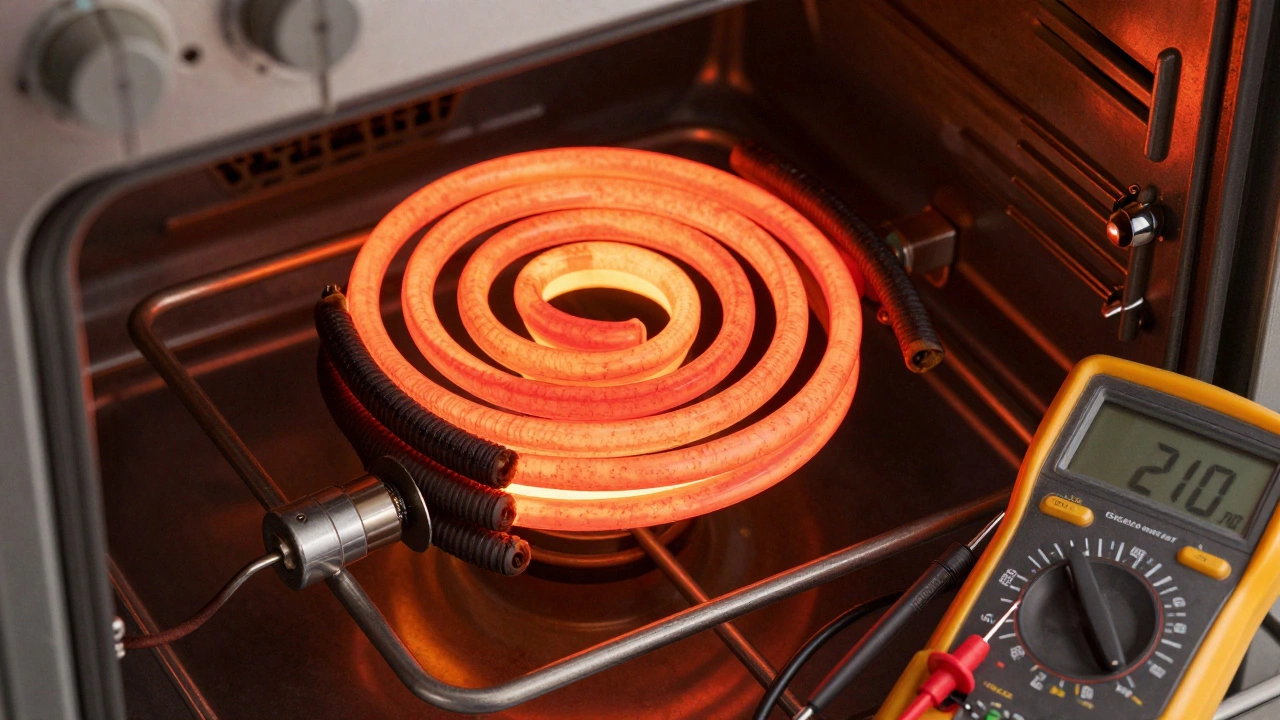
You don't need a degree in electrical engineering to figure out what's wrong, but you do need a Multimeter. This tool measures continuity-basically checking if electricity can flow from one end of a part to the other. If the circuit is broken, the part is dead.
- Kill the Power: This is the most important step. Turn off the oven at the circuit breaker. Touching a live 240V line is not a mistake you want to make.
- Visual Inspection: Pull the heating element out (if possible) and look for blisters, cracks, or spots where the metal has melted. A visible break is an instant diagnosis.
- Testing for Continuity: Set your multimeter to Ohms (Ω). Touch the probes to the terminals of the heating element. If the meter reads "OL" or infinite resistance, the element is snapped internally and needs to be replaced.
- Check the Thermal Fuse: If the oven won't turn on at all, check the thermal fuse. This is a safety device that kills power if the oven overheats. If it's blown, the oven won't even start until it's replaced.
- Verify the Sensor: Test the temperature sensor. Most sensors have a specific resistance value at room temperature (e.g., 1000 ohms). If your reading is wildly different, the sensor is lying to the control board.
When to DIY vs. When to Call a Pro
Replacing a heating element is a great beginner project. It usually involves removing a few screws and two wires. It's straightforward, and the parts are widely available. If you can handle a screwdriver and follow a YouTube video, you can probably do this yourself.
However, once you get into the Electrical Wiring of the main chassis or the internal gas-electric hybrids, the risk increases. If you see charred wires or smell burning plastic coming from the control panel, that's a red flag. High-voltage electricity can cause fires if a connection isn't tight or if the wrong gauge of wire is used.
You should also call a professional if the oven is under warranty. Opening the casing or breaking a factory seal usually voids your guarantee. If you've spent $2,000 on a high-end smart oven from a brand like Bosch or Miele, let the authorized technician handle it so you don't lose your coverage.
Avoiding Future Breakdowns
Electric ovens generally last 10 to 15 years, but you can push that limit with a bit of care. First, stop using the oven as a storage space for heavy cast-iron pans. Putting too much weight on the bottom rack can actually warp the heating element or dent the oven floor, creating hotspots.
Keep the interior clean. While you shouldn't scrub the elements with harsh chemicals, removing grease buildup from the walls prevents "smoke events" that can trigger the thermal fuse. Also, if you live in an area with unstable power, consider a high-quality surge protector for your kitchen circuit to protect the sensitive electronics in the control board.
Is it worth fixing an old electric oven?
Yes, in most cases. A new oven can cost anywhere from $500 to $3,000, while a replacement heating element or sensor typically costs between $30 and $150. Unless the oven's frame is rusted through or it's an ancient model that is incredibly energy-inefficient, replacing a specific part is the most economical choice.
Why does my electric oven heat unevenly?
Uneven heating usually happens because one of the heating elements (either the top broiler or bottom bake element) has partially failed. It might still work, but it can't reach the full temperature across the entire surface. This is common in older units where the element has developed "cold spots" due to wear.
Can I replace the oven element myself?
Absolutely. It's one of the most common DIY repairs. You simply disconnect the power, unscrew the old element, pull the wires through the oven wall, and plug in the new one. Just make sure you buy a part that matches your exact model number to ensure a proper fit.
What does it mean when the oven display is blinking?
A blinking display is often a signal from the control board that an error has occurred. This could be a failed sensor, a door that isn't latched properly, or a power surge. Try resetting the oven by flipping the circuit breaker for 60 seconds; if the error persists, you likely have a faulty component.
How do I know if the thermostat is broken?
The best way is to use an independent oven thermometer. Place it in the center of the oven and let it preheat. If there is a gap of more than 15-20 degrees between the oven's dial setting and the thermometer's reading, your thermostat or temperature probe is likely malfunctioning.
Next Steps and Troubleshooting
If you've followed this guide and your oven still isn't working, consider these scenarios based on your situation:
- If you're a renter: Do not attempt repairs. Most lease agreements forbid altering major appliances. Contact your landlord immediately to avoid being held liable for damages.
- If you're a homeowner with an old unit: If the repair cost exceeds 50% of the cost of a new, energy-efficient model, it's time to upgrade. Modern ovens use significantly less electricity.
- If the oven is brand new: Check your manual for "Child Lock" or "Demo Mode." It sounds silly, but many people think their new oven is broken when it's actually just in a showroom mode that doesn't activate the heat.