Oven Repair vs Replacement Cost Calculator
Calculate Your Oven Cost Breakdown
See if repairing your 20-year-old oven makes financial sense compared to replacing it.
Results
Enter your oven details above to see cost comparison results
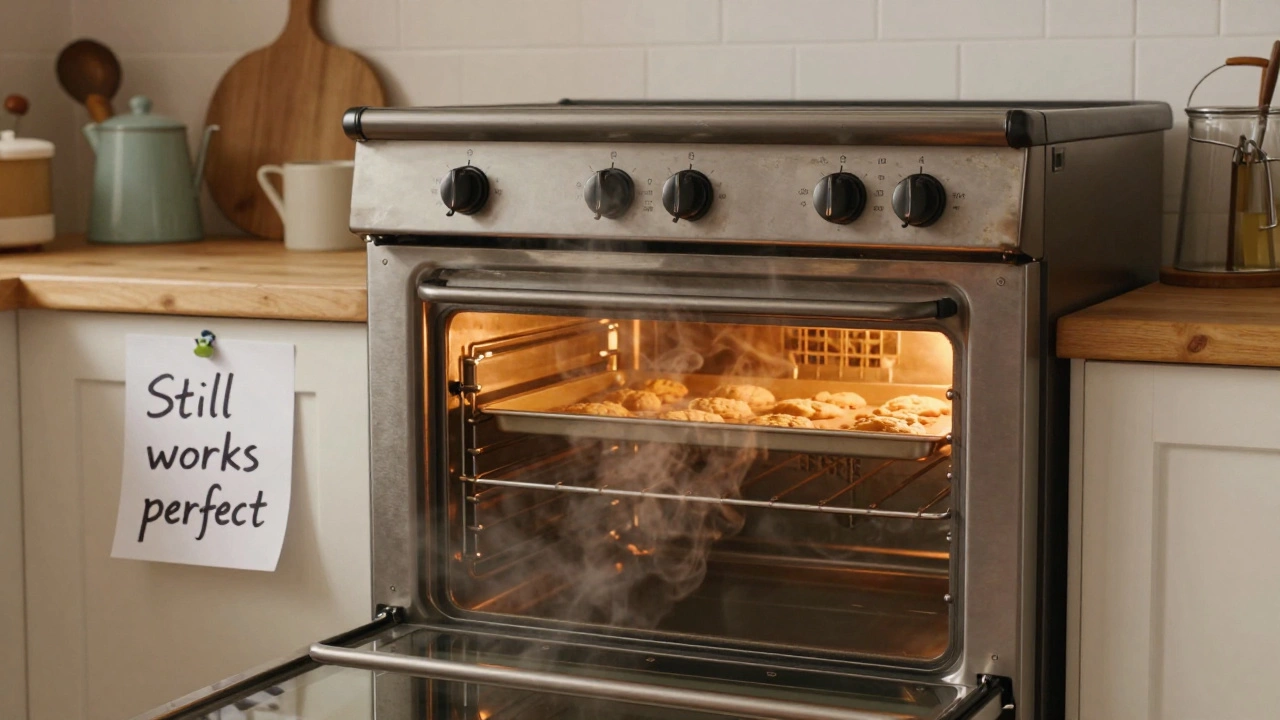
You’ve got a 20-year-old oven that still bakes cookies just right. The timer clicks like a metronome, the heating element glows orange without a hitch, and you’ve even memorized the exact spot where the door needs a little push to seal. But now, the temperature’s off by 50 degrees, or the control panel flickers, or the igniter won’t spark. You’re staring at it, wondering: can a 20-year-old oven be repaired? The answer isn’t yes or no-it’s maybe, but here’s how to know for sure.
Age isn’t the dealbreaker-condition is
People assume anything older than 15 years is scrap. That’s not true. Many ovens from the early 2000s were built like tanks: thick steel, solid wiring, mechanical thermostats, and parts made to last. Compare that to today’s models, where a cracked control board can kill the whole unit because everything’s glued together with plastic and software.
Real-world example: A customer in Norwood brought in a 1998 Westinghouse oven. The bake element was dead. We replaced it-$85 for the part, $120 labor. It’s still working five years later. That oven was 26 years old when we fixed it. The same model, if bought new today, would cost $1,200 and likely break in seven.
Age matters only if the oven has been abused. Water leaks? Rust inside the cavity? Burnt wiring from DIY attempts? That’s a red flag. But if it’s been cleaned regularly, never overloaded, and kept dry? It’s probably in better shape than your neighbor’s brand-new Samsung.
What parts actually wear out-and can be replaced
Most failures in older ovens aren’t catastrophic. They’re simple, replaceable parts. Here’s what actually breaks, and whether it’s worth fixing:
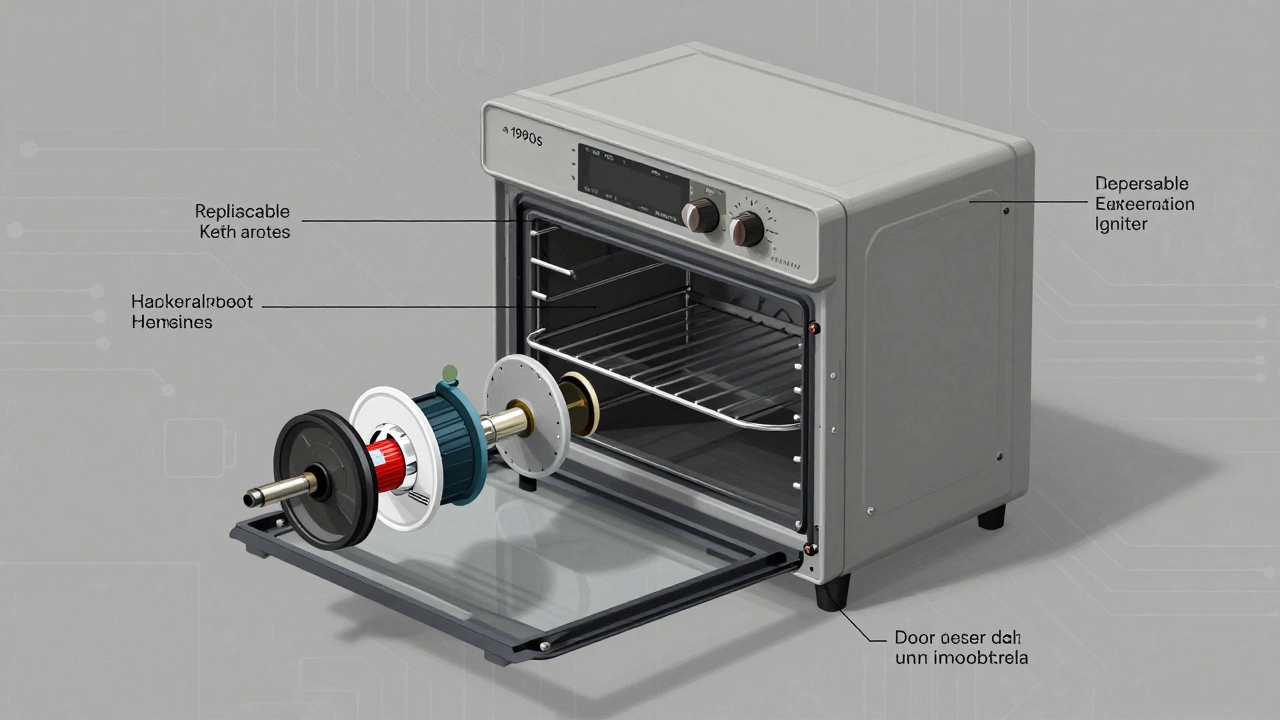
- Bake and broil elements-These are the heating coils. They fail often after 15+ years. Easy fix. Cost: $40-$100.
- Thermostat or temperature sensor-If your oven runs too hot or too cold, this is usually the culprit. Older ovens use mechanical thermostats; newer ones use digital sensors. Both can be swapped. Cost: $50-$150.
- Igniter (gas ovens)-If the oven doesn’t light but you hear clicking, the igniter’s weak. Common in gas models. Cost: $60-$120.
- Door seal-A cracked or brittle gasket lets heat escape. Easy to replace. Cost: $25-$60.
- Control panel buttons or display-This is where things get tricky. If the buttons are unresponsive or the display is blank, you might need a new control board. For older models, these are often discontinued. But sometimes, a repair shop can refurbish or bypass the board.
Here’s the truth: 80% of oven failures in units over 15 years old are fixable with parts still in circulation. Companies like Appliance Parts Warehouse, Repair Clinic, and even eBay have stock for models from the 1990s and early 2000s. You don’t need a miracle to find a replacement.
When repair isn’t worth it
There are three clear cases where you should walk away:
- The control board is dead and unavailable. If your oven uses a proprietary digital board and the manufacturer stopped making it after 2005, you’re stuck. No one can source it, and no one will make a universal replacement. This is rare, but it happens with high-end or niche brands.
- There’s structural damage. Rust through the inner cavity, cracked enamel lining, or warped door hinges? That’s not just cosmetic-it’s unsafe. Heat escapes, fire risk increases. No repair fixes that.
- You’ve already spent more than half the cost of a new oven. If you’ve replaced the element, thermostat, and igniter over the last three years, and now the display’s out? You’re chasing ghosts. A new basic oven costs $500-$700. If you’ve spent $400 already, it’s time to replace.
One guy in Glenelg spent $580 fixing his 1999 GE oven-three repairs in two years. He finally bought a new Bosch for $620. He got a 10-year warranty, energy savings, and a self-cleaning feature he never used. Sometimes, letting go is the smarter move.
Cost comparison: Repair vs. Replace
Let’s say your oven is 20 years old and not heating. Here’s what you’re looking at:
| Option | Cost | Lifespan After Fix | Energy Efficiency |
|---|---|---|---|
| Repair (element + thermostat) | $150-$250 | 5-10 years | Same as before (15-20% less efficient than new) |
| Replace (basic model) | $500-$700 | 10-15 years | 30-40% more efficient |
| Replace (energy-star model) | $800-$1,200 | 12-18 years | 50%+ more efficient |
Here’s the math: If your old oven uses 1.5 kWh per hour of baking, and you bake 10 hours a month, you’re spending about $180 a year on electricity. A new energy-star oven uses 0.8 kWh-cutting your bill to $96. You save $84 a year. That means the extra $300 you spend on a better model pays for itself in 3.5 years.
How to decide: The 3-question test
Before you call a repair tech or head to the appliance store, ask yourself:
- Is the oven still reliable for daily use? Does it heat evenly? Does it hold temperature? If yes, it’s worth fixing.
- Can you find the part? Google the model number + “replacement part.” If you see three suppliers selling it, go ahead. If you get zero results, skip it.
- Do you love it? Not just “it works.” Do you like the way it cooks? Do you feel attached to it? If you do, and the repair is affordable, keep it. Emotional value counts.
There’s no rule that says you must replace something after 15 years. That’s just marketing. Real lifespan? It’s 25-30 years for well-maintained ovens. I’ve seen 40-year-old Frigidaire ovens still in use in country homes. They’re not fancy, but they’re solid.
What to do next
If you’re thinking about repair:
- Find the model number. It’s usually on a sticker inside the door frame or on the back.
- Search online for that model + “common problems.” You’ll see what others have fixed.
- Call a local repair shop. Ask: “Do you carry parts for [model number]?” If they say yes, book a diagnostic. Most charge $50-$80 for this, and it’s often applied to the repair cost.
- Don’t let them pressure you into replacement. If they say “it’s not worth fixing,” ask why. If they can’t name the specific part that’s unavailable, they’re guessing.
If you’re leaning toward replacement:
- Look for models with mechanical controls, not touchscreens. They last longer.
- Check for a 10-year warranty on the heating elements.
- Consider a dual-fuel model if you cook often. Gas burners + electric oven = better control.
Frequently Asked Questions
Is it safe to use a 20-year-old oven?
Yes, if it’s in good condition. Check for rust inside the cavity, cracks in the door seal, or frayed wires. If those are absent and the oven heats evenly, it’s safe. Older ovens don’t have the same safety sensors as new ones, so you need to be more attentive-don’t leave it unattended for long periods, especially if you notice strange smells or sparks.
Can I replace the control panel myself?
Only if you’re comfortable working with electricity. Most control panels are connected to live wiring. If you’ve never changed a light switch, don’t try this. Even experienced DIYers often damage the board during removal. A pro can do it in 45 minutes with the right tools. It’s not worth the risk unless you’re confident.
Do newer ovens really save that much on energy?
Yes. A 20-year-old oven typically uses 1.4-1.8 kWh per hour. Modern energy-star models use 0.8-1.0 kWh. That’s a 30-50% drop. If you bake 15 hours a month, you’re saving $100-$150 a year. Over 10 years, that’s $1,000-$1,500 in savings-enough to cover the cost of a new oven and then some.
Why do repair shops say my oven isn’t worth fixing?
Sometimes they’re right-parts are gone, or the damage is too deep. But sometimes, they’re pushing replacement because it’s more profitable. Ask for the exact part number that’s unavailable. If they can’t name it, get a second opinion. Reputable shops will show you the part on their website or in their inventory.
Are vintage ovens harder to repair because they’re outdated?
Not necessarily. Older ovens use simpler, more universal parts. A 1995 oven’s thermostat might be the same as a 2002 model. Modern ovens have proprietary boards and software locks. In fact, many repair techs prefer working on older units because they’re easier to diagnose and fix. It’s not about age-it’s about design.
Final thought
Your 20-year-old oven isn’t a relic. It’s a survivor. It’s seen kids grow up, holidays, burnt roasts, and midnight snacks. It’s earned its place. Don’t throw it out because a salesperson told you it’s “obsolete.” Fix it if you can. Replace it if you must. But don’t let fear or marketing make the decision for you.